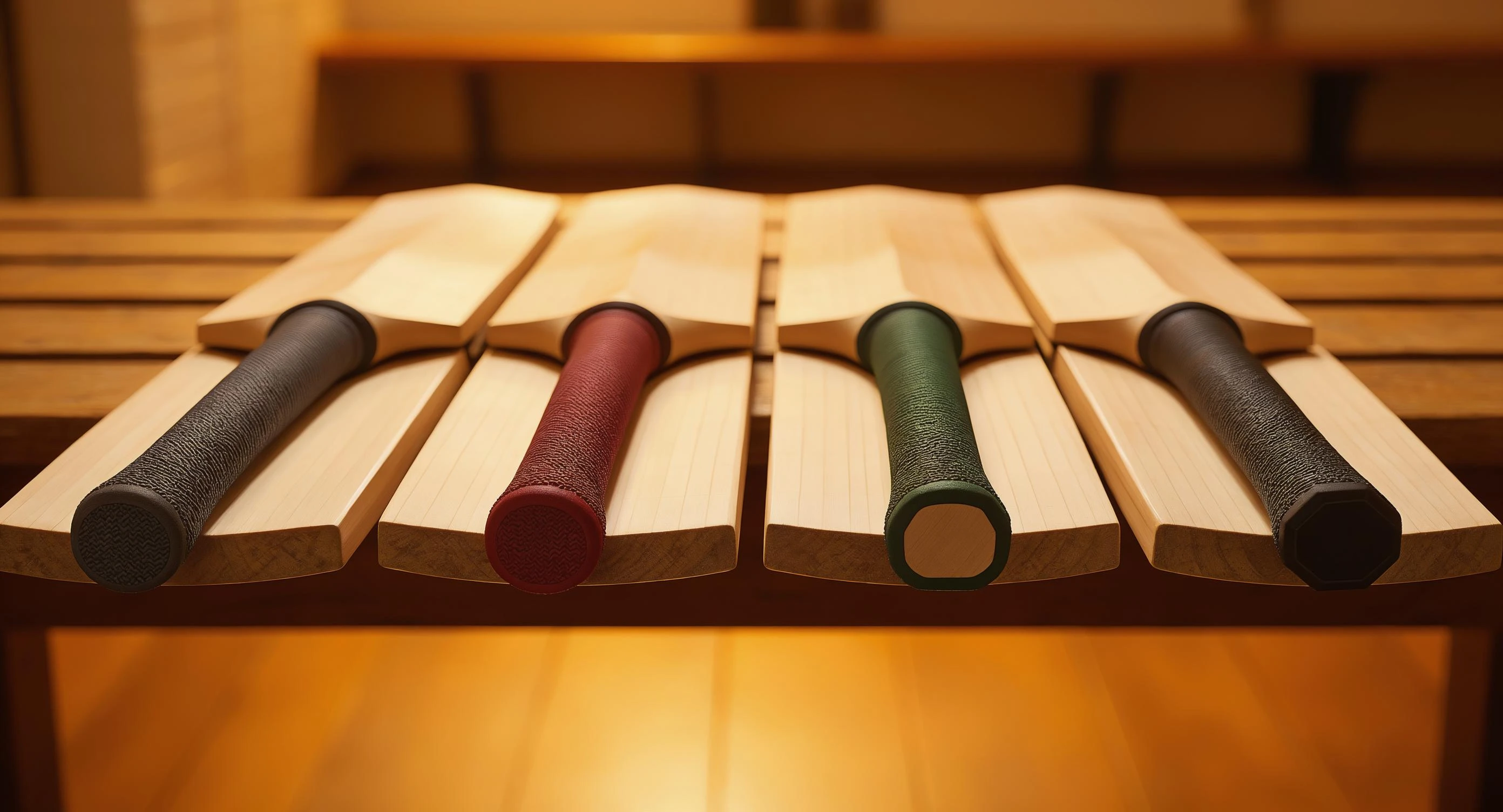
Cricket Bat Handle Types: The Ultimate Player’s Guide 2026
The Part of the Bat Nobody Talks About (But Everyone Feels)
You're mid-innings. The ball is swinging. Your hands are sweaty. And the bat slips, just enough to mis-time what should have been a boundary.
Nine times out of ten, the culprit isn't your technique. It's your handle.
The handle is the most underrated piece of engineering in a cricket bat. Understanding different Cricket bat handle types can completely change how a bat feels and performs in your hands. It controls how vibration travels through your hands, how naturally you can rotate your wrists for shots, and how much control you have over the blade. Choose the wrong one, and even the best willow in the world will feel wrong.
This guide breaks down every major cricket bat handle type: what they are, who they're designed for, and how they affect your game. Whether you're a weekend club player or grinding through age-group cricket, this is the information that most bat sellers never bother to tell you.
What Makes a Cricket Bat Handle Different from One Bat to Another?
Before diving into Cricket bat handle types, it helps to understand what a cricket bat handle actually consists of:
-
Core material: Almost universally cane (Malacca or Sarawak), because it's lightweight, flexible, and absorbs shock effectively
-
Spring construction: Strips of cane are separated by rubber strips, creating a spring-like structure that damps vibration
-
Cross-section shape: This is what varies most and what defines the "handle type"
-
Handle grip: The rubber or composite sleeve wrapped around the outside
The cross-sectional shape of the handle dictates how the bat sits in your hands, how easily it rotates, and which shots feel natural versus forced, something that becomes even more noticeable across different Types of Cricket Bats.
The Main Types of Cricket Bat Handles
Each of these Cricket bat handle types is designed to suit a different batting style, grip preference, and shot selection.
1. Round Handle
The round handle has a perfectly circular cross-section from top to bottom, giving it a uniform feel in every direction. Among all Cricket Bat Handle Types, the round handle is usually preferred by aggressive stroke players.
Who uses it: Round handles are particularly popular with batters who play a lot of wristy, rotational shots including cuts, glances, sweeps, and leg-side flicks. Because there's no dominant flat face to "feel," the bat rotates freely in the hands without resistance.
Key advantages:
-
Excellent for 360-degree stroke play
-
Naturally suits players with larger or meatier hands
-
Common in bats designed for aggressive, attacking batters
-
Easier grip rotation for flick shots and pulls
Watch out for: Some batters find a round handle gives less intuitive feedback about where the bat face is pointed, which can be disorienting early on, particularly for straight-drive lovers.
Best for: Aggressive middle-order and T20 batters; players who dominate the leg side.
2. Oval Handle
The oval handle has a flattened cross-section. Think of a circle that's been gently compressed front-to-back. This is one of the most common handle shapes in professional cricket.
Who uses it: Oval handles are favoured by batters who rely on timing and placement over raw power. The slight flattening gives you a natural tactile cue so your hands always know where the bat face is, even mid-swing.
Key advantages:
-
Better bat-face awareness through feel
-
Ideal for technically correct, straight-bat drives
-
Reduces wrist torque on mis-hits (the oval resists rotation slightly)
-
Generally considered the most all-round handle shape
Watch out for: The slight resistance to rotation can make wristy leg-side shots marginally harder to execute at pace.
Best for: Opening batters, top-order players, and anyone who prioritises technique and timing over brute force.
3. Semi-Oval Handle (Oval-Round)
The semi-oval sits between round and oval. One side is flatter than the other, but it's less pronounced than a true oval. Many manufacturers label this differently, calling it "oval-round" or "modified oval."
Who uses it: This is arguably the most versatile handle shape available. It gives you some positional awareness without fully restricting wrist freedom. Many players consider semi-oval designs the most balanced option among different types of cricket bat handles.
Key advantages:
-
Combines the best of both round and oval
-
Works across batting styles and positions
-
Good choice if you're unsure which way to go
-
Comfortable for players transitioning from one style to another
Best for: All-rounders, batters who play at No. 5 to 7, players experimenting with expanding their game.
4. Octagonal Handle (Less Common)
Some specialty bats, particularly older designs and certain heritage-style willow, feature an octagonal handle with eight distinct flat faces.
Who uses it: Rarely seen in modern professional cricket, but still found in some traditional English-made bats and certain Junior and Youth Bats, where the goal is to teach correct grip naturally.
Key advantages:
-
Strong tactile feedback so you always know your grip position
-
Helps young or developing batters maintain consistent hand placement
-
Historically popular in the era of heavy, high-spine bats
Watch out for: Can feel rigid and unforgiving. Not suitable for aggressive rotational play.
Best for: Young players learning grip fundamentals; coaches who want to enforce correct technique.
5. Tapered vs. Uniform Handles
Beyond cross-section shape, handles also differ in their profile along the length, specifically how they taper (or don't) from top to bottom. This is one of the lesser-known details that separates premium types of cricket bat handles from standard factory designs.
Tapered handle: Wider at the top, narrowing slightly toward the blade. This design concentrates grip at the top of the handle, which can help with leverage on big hits and drive shots.
Uniform handle: Consistent diameter throughout. Gives an even feel and is preferred by batters who like a controlled grip without the top hand dominating.
This is a detail most bat guides skip entirely. If you've ever held two bats of the same "handle type" that felt completely different, tapering is often why.
6. Short vs. Long Handle (Length Variants)
Short vs. Long Handle cricket bat is a separate but equally critical variable:
|
Handle Length |
Best For |
Typical Use |
|
Short handle |
Batters under ~5'9" |
Most club and professional bats |
|
Long handle |
Tall batters (5'10"+) |
Offers more reach and leverage |
|
Harrow handle |
Junior/youth (under 13-14) |
Smaller bats, shorter grip zones |
|
Men's short handle |
Standard adult |
The default in most off-the-shelf bats |
Getting handle length wrong is one of the most common fitting mistakes, particularly when players don’t properly compare cricket bat sizes before buying. A handle that's too short forces you to grip lower on the blade, which affects balance and control dramatically.
Handle Material: Cane Springs and Rubber Inserts
AWhile handle construction stays fairly consistent, the overall bat feel can still vary significantly depending on whether you're using English or Kashmir willow. This rubber-cane sandwich acts as a shock absorber, reducing the sting on mis-hits.
The number of rubber strips matters:
-
More rubber strips = softer feel, more vibration damping, better for hard wickets
-
Fewer rubber strips = firmer feel, better feedback, preferred by some technically precise batters
Premium bats often use Sarawak cane, a denser, higher-grade cane from Malaysian Borneo, which offers superior spring and durability over standard Malacca, a detail commonly found in higher cricket bat grades.
When evaluating a bat, ask about the cane grade. It's rarely advertised, but it significantly impacts how the handle performs over time.
How Your Handle Type Affects Shot Selection
This is the practical bit that most guides gloss over. Here's a direct breakdown:
- Drives (on and off): Oval handle gives face awareness and natural top-hand dominance.
- Pull and hook shots: Round handle provides wrist freedom and easy rotation.
- Cut shots: Semi-oval offers the right balance of control and freedom.
- Sweep and reverse sweep: Round handle allows maximum wrist flexibility.
- Straight drive: Any handle works, but oval gives the most consistent alignment.
- Big hits (sixes): Round or semi-oval makes it easier to swing through the line freely.
If your game is primarily about accumulation and placement, go oval. If you're looking for a more aggressive performance cricket bat setup built around fast hands and attacking stroke play, round handles usually suit better.
Common Handle Problems (and What They Signal)
1. Bat twisting in your hands mid-shot: Usually means your handle is too round for your grip style. You need more oval feedback.
2. Wrists feeling stiff or restricted: The handle may be too oval, fighting your natural wrist rotation. Try a semi-oval.
3. Tingling or sting on mis-hits: Could be insufficient rubber strips in the handle spring. This is a construction quality issue, not a shape issue.
4. Handle feeling "dead": Cane has likely degraded. Quality cane handles retain spring for years; cheap cane collapses quickly.
5. Grip slipping under pressure: This is usually a grip sleeve issue, though a poorly shaped handle does make grip retention harder over time.
Choosing the Right Handle: A Quick Decision Framework
Answer these three questions:
1. What's your dominant batting style?
-
Accumulator / technically correct player: Oval
-
Aggressive / T20 destroyer: Round
-
All-rounder: Semi-oval
2. What's your hand size?
-
Smaller hands: Oval or semi-oval (more feedback with less grip strength required)
-
Larger hands: Round (fills the hand naturally)
3. What's your strongest scoring zone?
-
Off side dominant: Oval
-
Leg side dominant: Round
-
Both equally: Semi-oval
Final Thoughts: Don't Overlook the Handle
The willow gets all the glory. The handle does the real work.
Your handle is the only part of the bat you actually touch. Every shot you play, every drive, cut, pull, and flick, is mediated through those six or seven inches of cane and rubber. Getting it right won't automatically make you a better batter, but getting it wrong will consistently hold you back.
If you've never consciously chosen a handle type before, this is the moment to start, especially if you're using a broader bat selection guide to understand how bat shape, balance, and handle profile work together. Next time you're picking up a bat, even during net sessions with a practice cricket bat, rotate it in your hands, feel how it sits, and ask yourself: Does this feel like an extension of my arms, or is it fighting me?
The right handle will feel like the former.
Frequently Asked Questions
1. Which handle is best for power hitting?
The round handle is best for power hitting because its circular shape lets the wrists rotate freely and explosively, making it ideal for pull shots, slog sweeps, and big sixes. Pair it with a thick-edged bat and you have the go-to combination for any T20 finisher.
2. Does handle type affect how hard I can hit?
Yes, indirectly. A round handle enables faster wrist rotation, which increases bat speed and power on rotational shots like pulls and flicks. For straight-bat drives, handle length and grip placement matter more than shape.
3. Is an oval or a round handle better for beginners?
Oval handles are often the safest option when choosing a Cricket Bat for Beginners because the flattened shape gives better bat-face awareness and helps build correct grip habits early. Round handles make more sense once your technique is established and you want greater freedom in shot-making.
4. Can I change the handle type on my existing bat?
Yes, a skilled bat maker can replace the handle, but it involves carefully removing the old one and re-pressing the new handle into the blade. It's worth doing on a premium bat; on a budget bat, buying a new one may make more practical sense.
5. What handle do most international cricketers use?
Most professional batters prefer oval or semi-oval handles for the balance of control and feedback they provide at the highest level. Players with aggressive, leg-side heavy games often lean toward the rounder end of the oval spectrum.
6. Does handle length affect my stance and backlift?
Yes, significantly. A handle that's too short creates a bottom-hand dominant grip and limits backlift, while one that's too long pushes the hands too high and disrupts timing and balance.




Related Blog
English Willow vs. Kashmir Willow: Choosing the Right Cricket Bat for Your Game
Nov 13, 2025 by Admin
ANA Sports